
Blueprint for regulatory acceptance of real-world walking speed (RWS) outcomes - call for focused partnerships
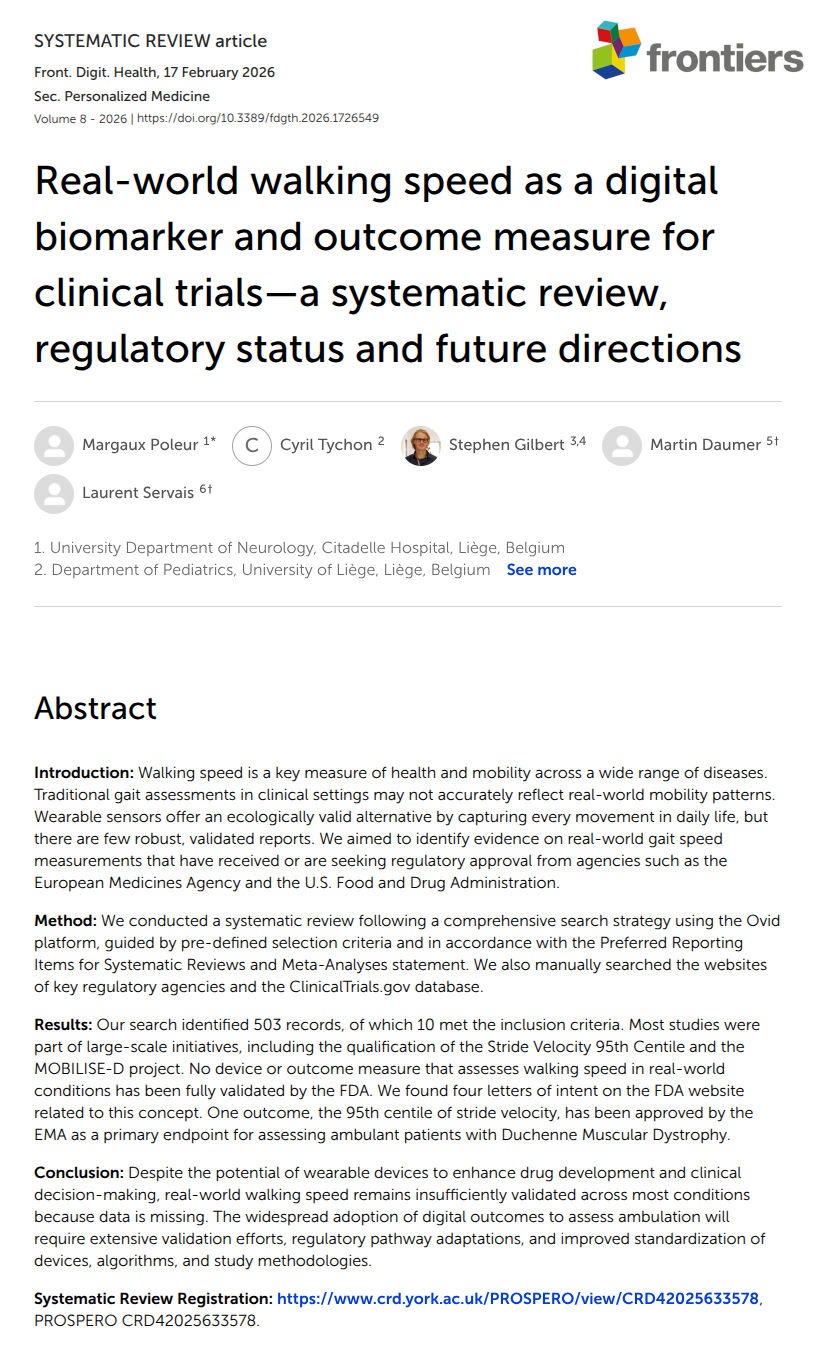
A new systematic review in Frontiers in Digital Health provides a clear and actionable blueprint toward regulatory acceptance of real-world walking speed (RWS) as a clinical trial outcome, particularly in diseases where the 6-minute walk test (6MWT) is already regulator-familiar (e.g., MS, neuromuscular disorders, and also cardiovascular disease).
frontiersin.org/journals/digital-health/articles/1...
The review highlights that an RWS-based endpoint (stride velocity 95th centile) has already been qualified by EMA in ambulant Duchenne muscular dystrophy, demonstrating that acceptance is achievable with a well-defined context of use and a structured evidence package. It also summarizes ongoing interactions with FDA.
In MS, long-standing trial methodology work reinforces the limitations of traditional outcomes and the need for more ecologically valid functional measures:
pubmed.ncbi.nlm.nih.gov/18480462/
pubmed.ncbi.nlm.nih.gov/19073945/
pubmed.ncbi.nlm.nih.gov/35636268/
The key message is that progress now depends on finding the right partners to collect robust datasets and document results in well-known regulatory formats. Large, complex initiatives (e.g., IMI-like structures) have often faced major operational obstacles; focused, lean consortia may be more effective.
This topic has been discussed in many previous Winter Symposia of the Human Motion Project (thehumanmotioninstitute.org) and will also be part of the upcoming symposium on March 10th:
humanmotioninstitute.de/content/event/248
See also: doi.org/10.3389/fdgth.2026.1726549